
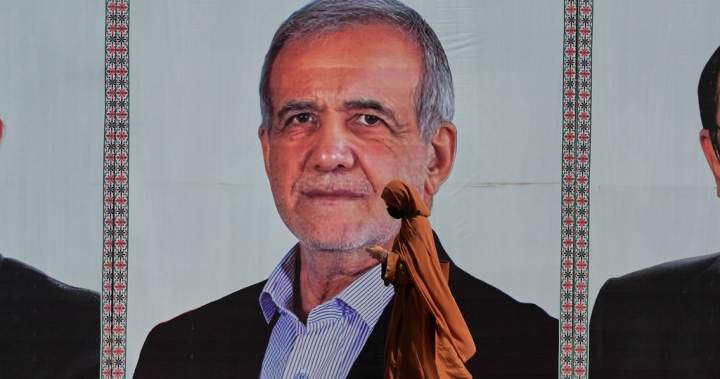
The Iranian president arrived Pakistan for talks on Tuesday with officials who are brokering negotiations between Tehran and Washington over a permanent end to the war in the Middle East, despite disagreements in previous agreements and renewed violence in Lebanon.

President Masoud Pezeshkian’s visit to Islamabad comes as technical teams worked on details of the agreement led by the US vice president following high-level negotiations in Switzerland on Monday JD Vance and Iran’s parliament speaker Mohammad Bagher Qalibaf.
In Tehran, Iran Foreign Ministry spokesman in the capital, Esmail Baghaei, told reporters that no visits were planned for the UN watchdog agency – the International Atomic Energy Agency – to investigate Iranian nuclear facilities bombed by the United States last year. Vance previously said negotiations in Switzerland had resulted in an agreement to allow inspectors to visit the sites.
The IAEA has been in and out of Iran since Israel’s 12-day war in 2025, but has not been granted access to the bombed enrichment sites targeted by the US at the time.
Meanwhile, violence erupted again in southern Lebanon when Israeli soldiers opened fire, killing two people. The reports of violence came after two days of calm following a ceasefire negotiated on Saturday. Any resumption of heavy fighting could jeopardize broader diplomatic talks, as Iran has demanded that a full ceasefire in Lebanon be part of a comprehensive deal.
The Iranian president visits Islamabad for the first time since the start of the war
According to Pakistani state media, Pakistani President Asif Ali Zardari, Prime Minister Shehbaz Sharif and other senior officials received Pezeshkian amid tight security upon his arrival in Islamabad. Television footage showed Pezeshkian hugging Zardari and Sharif as they greeted him.
Iranian Foreign Minister Abbas Araghchi also took part in the delegation in Islamabad.
It is the first visit by the Iranian president since the conflict began with the US and Israeli attack on Iran on February 28th.
Pezeshkian and Sharif were scheduled to hold a joint press conference after their talks.

In the first talks that mark the start of a 60-day diplomatic process aimed at reaching a lasting agreement to end the Iran war, Iran and the US agreed to set up a “conflict resolution cell” to address fighting in Lebanon between Israel and the Iran-backed militant Hezbollah group. The US said negotiators also discussed “mechanisms” to ensure that the Strait of Hormuz, a key waterway for oil transit that Iran had effectively blocked during the war, remained open.

Get national news daily
Get Canadian news delivered to your inbox daily so you never miss the day’s top stories.
Ahead of his meetings in Pakistan, Pezeshkian warned that “the effectiveness of the talks depends on full compliance with the agreed commitments and their precise implementation.”
“Progress along this path will be measured by practical compliance with the responsibilities assumed,” he wrote on X. “Statements outside the agreed text do not help advance negotiations.”
Iran said the negotiating groups focused on sanctions relief, nuclear issues and more
According to state news agency IRNA, Iran indicated that ongoing talks in Switzerland had led to the formation of specific negotiating groups, including those focused on sanctions relief, nuclear issues, reconstruction and surveillance.
The report quoted Kazem Gharibabadi, a deputy foreign minister who led the technical discussions, as saying the countries involved had also formed a contact mechanism about ships passing through the Strait of Hormuz and fighting between Israel and Hezbollah in Lebanon.
It remains unclear whether the deconfliction cell created will be enough to end fighting between the Lebanese militant group Hezbollah and Israel, which occupies part of Lebanon and insists it must be able to attack militants who launch attacks on northern Israel.
Israeli forces opened fire in the southern Lebanese town of Nabatiyeh al-Fawqa on Tuesday, killing two men, Lebanon’s state news agency National News Agency reported. The two were next to a bulldozer that was clearing a road.
Separately, the agency said Israeli troops fired on residents near the town of Hadatha as they headed to a funeral with a Lebanese army escort.
There was no immediate comment from Israel.
Discrepancy regarding Iran’s use of unfrozen funds
After the high-level talks in Switzerland, Vance said that if the Iranian financial assets were not frozen, they would be used to buy US-grown food.
Vance said the U.S. and Qatar had their consent to the process, but that if Iranian money became available after sanctions were lifted, it would “actually be used to purchase American soy, American corn and American wheat for the benefit of the Iranian people.”

However, Iran currently has no demand for U.S. crops and Baghaei said on Tuesday that Tehran’s decisions about what to import would be based on “prices and quality.”
“It is interesting that the philosophy and goal of the war, which was the destruction of Iranian civilization and the collapse of Iran, have become the enrichment of American farmers,” Baghaei said in Tehran.
Iran’s ambassador to Geneva, Ali Bahreini, also questioned Vance’s assertion that the U.S. and Qatar must approve how Iran uses unfrozen funds.
“Iran is the only country that decides what to do with these assets,” he told reporters.
Netanyahu raises new questions about Lebanon’s fragile ceasefire
Mediators Pakistan and Qatar said the cell would involve the Lebanese government and “ensure compliance with the cessation of military operations in Lebanon,” but Israeli Prime Minister Benjamin Netanyahu raised new questions late Monday, saying his military still had “full freedom of action to deter any direct or emerging threat to them or the residents of the north.”
Neither Israel nor Hezbollah are signatories to the U.S.-Iran deal, and Netanyahu has vowed to keep his forces in southern Lebanon until any threat to Israel is eliminated. Hezbollah has refused to stop attacks unless Israel commits to withdrawing.
When asked about Netanyahu’s comments, US President Donald Trump replied: “We will look at it” and added that the situation was being “resolved”.
The main road leading south from Beirut was clogged on Tuesday as displaced people from southern Lebanon returned to their homes. Among them was Hawraa Nour El-Din from the village of Khirbet Selm.
“We don’t want the negotiations to be led by the government,” she said. “We want Iran to negotiate on our behalf and we will return victorious, whether everyone likes it or not.”
No Israeli airstrikes or artillery strikes have been reported since Sunday, a day after a ceasefire was reached, and Hezbollah has not called for any attacks, marking the longest break in fighting since the latest war between Israel and Hezbollah broke out on March 2.
Lebanon and Israel planned another round of direct talks in Washington on Tuesday that would focus on developing a plan for an Israeli withdrawal.