
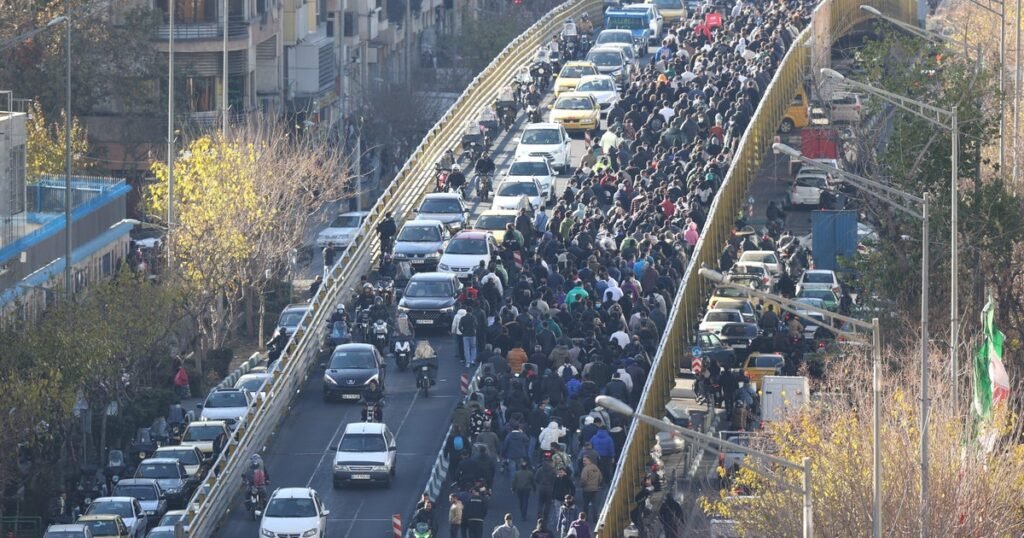
Extension Demonstrations The crisis sparked by Iran’s struggling economy spread to the Islamic Republic’s rural provinces on Thursday. At least six people were killed in the first fatalities reported among security forces and demonstrators, authorities said.
The deaths could be the start of a more forceful response by the Iranian theocracy to the demonstrations, which have subsided in the capital Tehran but expanded elsewhere. The deaths, one on Wednesday and five on Thursday, occurred in three cities predominantly home to Iran’s Lur ethnic group.
The protests are the largest in Iran since the death of a 22-year-old in 2022 Mahsa Amini in police custody sparked nationwide demonstrations. However, the demonstrations have not yet taken place nationwide and have not been as intense as those surrounding the death of Amini, who was arrested for not wearing her hijab, or headscarf, at the request of authorities.
During recent protests, which focused on economic issues, demonstrators also chanted against Iran’s theocracy. The country’s leadership is still reeling after Israel launched a 12-day war against the country in June. The US also bombed Iranian nuclear facilities during the war.
“The people of Iran want freedom. They have suffered at the hands of the ayatollahs for too long,” Mike Waltz, U.S. ambassador to the United Nations, said in an interview Post on X earlier this week.
“We stand with Iranians on the streets of Tehran and across the country as they protest against a radical regime that has brought them nothing but economic downturn and war,” he said.
Fars News Agency via AP 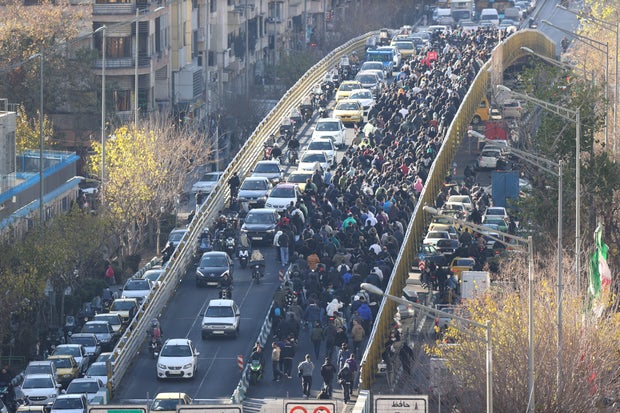
The most intense violence appears to have occurred in Azna, a city in Iran’s Lorestan province, about 185 miles southwest of Tehran. Online videos there are said to show burning objects in the street and the echoes of gunfire as people shout: “Shameless! Shameless!”
The semi-official Fars news agency reported that three people were killed. Other media outlets, including pro-reform outlets, cited Fars for the report, while state media did not fully acknowledge the violence there or elsewhere. It was not clear why there was no more coverage of the unrest, but journalists faced arrest for their reporting in 2022.
In Lordegan, a city in Iran’s Chaharmahal and Bakhtiari provinces, online videos showed protesters gathering on a street with the sound of gunfire in the background. The footage matched known features of Lordegan, about 290 miles south of Tehran.
Fars, citing an anonymous official, said two people were killed in Thursday’s protests.
Iran’s Washington-based Abdorrahman Boroumand Center for Human Rights said two people were killed there and identified the dead as protesters. A still image of what appeared to be an Iranian police officer wearing body armor and holding a shotgun was also shown.
In 2019, there were widespread protests in the Lordegan area and demonstrators reportedly damaged government buildings after a report that people there were infected with HIV from contaminated needles used at a local health clinic.
At a separate demonstration on Wednesday evening, a 21-year-old volunteer with the paramilitary Revolutionary Guard’s Basij force was reportedly killed.
State news agency IRNA reported the Guard member’s death but did not elaborate. An Iranian news outlet called Student News Network, which is believed to be close to the Basij, directly blamed the protesters for the Guard member’s death, citing comments from Saeed Pourali, a deputy governor of Lorestan province.
He reportedly said that the Guardsman “became a martyr at the hands of rioters during protests in this city in defense of public order.” Another 13 Basij members and policemen sustained injuries, he added.
“The protests that have occurred are due to economic pressures, inflation and currency fluctuations and reflect concerns about livelihoods,” Pourali said. “Citizens’ voices must be heard carefully and tactfully, but people must not allow their demands to be coerced by profit-seeking individuals.”
The protests took place in the city of Kouhdasht, more than 250 miles southwest of Tehran. Local prosecutor Kazem Nazari said 20 people were arrested after the protests and calm had returned to the city, the judicial news agency Mizan reported.
The Iranian civilian government under reformist President Masoud Pezeshkian is trying to signal that it wants to negotiate with the demonstrators. However, Pezeshkian has admitted there is not much he can do as Iran’s currency, the rial, has rapidly depreciated and a dollar now costs about 1.4 million riyals.
Meanwhile, state television separately reported the arrests of seven people, including five it described as monarchists and two others it said had links to Europe-based groups. State television also reported that security forces confiscated 100 smuggled pistols in another operation, without elaborating.
The Iranian theocracy had declared Wednesday a holiday in much of the country, citing the cold weather, likely as an attempt to drive people away from the capital for a long weekend. The Iranian weekend is Thursday and Friday, while Saturday marks Imam Ali’s birthday, another holiday for many.