

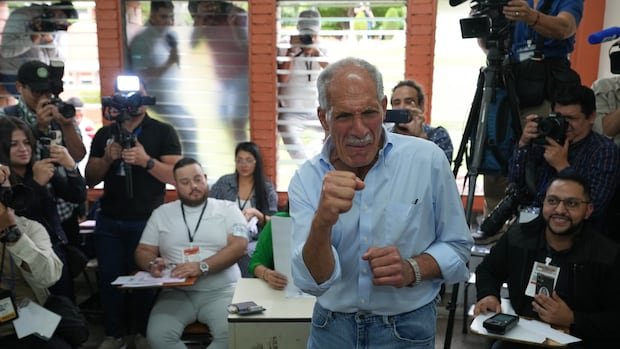
Two conservative challengers were virtually tied in Honduras’ presidential election, with votes from about 55 percent of polling stations counted early Monday, according to preliminary and partial results.
The vote came just days after President Donald Trump intervened in a close race by endorsing one of those candidates and announcing he would pardon a former president.
The National Electoral Council said Nasry (Tito) Asfura of the National Party had 40 percent of the vote in the first count, while Salvador Nasralla of the conservative Liberal Party had about 39.78 percent. Rixi Moncada of the democratic socialist LIBRE (Freedom and Refoundation Party) was behind with 19.49 percent.
Both Asfura and Nasralla said the count was too early and refused to declare victory. After initial excitement in the campaign headquarters of both parties, there was largely calm on the streets of the capital Tegucigalpa on Sunday evening as the counting progressed slowly.
Asfura, the 67-year-old former mayor of Tegucigalpa Who received Trump’s support?He appeared as a pragmatic politician and referred to his popular infrastructure projects.
Nasralla, a 72-year-old sports reporter, has campaigned for various parties over the years and even joined current President Xiomara Castro four years ago.

As preliminary results emerged late Sunday, Nasralla said the race was still too close to cancel. He expressed confidence that the remaining vote counts would be in his favor.
Nasralla sought to use Trump’s interference to bolster his own cultivated outsider status, even though it was his fourth bid for the presidency.
“I do not stand before dark pacts, corrupt networks or criminals who have killed our people,” he said.
“Shocking” apology
Trump on Friday endorsed Asfura, saying he could work with him to fight drug trafficking and that “the United States will not throw good money after bad if he doesn’t win,” without elaborating.
“I cannot work with Moncada and the communists, and Nasralla is not a reliable partner for freedom and cannot be trusted,” Trump posted on Truth Social.

Trump was also shocked when he announced he would pardon former President Juan Orlando Hernández, who has been serving a 45-year sentence in a U.S. prison for a year for helping drug traffickers transport tons of cocaine into the United States.
Prosecutors said Hernández used Honduras’ military and police to route drug shipments through the country, earning him millions of dollars that fueled his political rise from rural congressman to president.
But Trump criticized the prosecution of Hernández, a wide-ranging case that also involved the former president’s brother, and said Friday that people he respects had told him that Hernández, who belonged to the National Party, was “treated very harshly and unfairly.”
The move angered Democrats in Washington as Trump used the alleged flow of drugs into the US as a legal basis for a series of attacks on ships near Venezuela and in the eastern Pacific that have killed more than 80 people since September 2.
Sen. Tim Kaine of Virginia called Trump’s decision to pardon Hernández “shocking.”
“He was the leader of one of the largest criminal enterprises ever convicted in U.S. courts, and less than a year after his conviction, President Trump pardoned him, indicating that President Trump doesn’t care about drug trafficking,” Kaine said on CBS Face the nation.
Front burner29:32Will the US invade Venezuela?
Candidates make noises about not accepting the result
Oliver Erazo, a law professor at the National Autonomous University of Honduras, said he doesn’t expect Trump’s interference to have a major impact on voters’ decisions.
“The social and collective behavior of the electorate was already defined a week or two ago, particularly when it comes to the National Party and the Liberal Party,” he said.
Honduras, where six out of 10 citizens live in poverty, experienced a coup in 2009 when an alliance of right-wing military officers, politicians and businessmen overthrew Manuel Zelaya, the current president’s husband.
In 2017, the first Trump administration endorsed Hernández’s re-election, although the Organization of American States called for a re-election due to widespread allegations of fraud. Hernández’s bid for a second term was itself controversial, as he won a Supreme Court ruling to circumvent a ban on consecutive terms in office under the country’s 1982 constitution.
The period between the end of the election and the inauguration was marked by widespread protests.

In 2021, Hondurans voted overwhelmingly for Xiomara Castro, ending more than a century of Nationalist and Liberal rule.
The final stages of this campaign were marked by allegations by the three leading candidates of vote-rigging, prompting Honduran and international observers to warn that they could undermine acceptance of the result.
Moncada, current President Castro’s hand-picked successor, said in the days before the election that she would not accept the preliminary numbers because she believed there was a conspiracy to manipulate them.
She said she would not comment on the electoral council’s preliminary results until Monday.
Meanwhile, there were concerns in the opposition that the ruling LIBRE would use government levers to give Moncada a competitive advantage.
U.S. Assistant Secretary of State Christopher Landau warned in a statement earlier that Washington would respond “swiftly and decisively to anyone who undermines the integrity of the democratic process in Honduras.”
Melany Martínez, a 30-year-old nurse, said she heard conversations on the street about the possibility of trouble after the vote and even suggestions to stock up on household essentials. She was also frustrated by the US President’s intervention.
“I think this is where the people’s decision has to be made because in the end we are the citizens,” she said.
Concerns about safety and employment were top of mind for many voters.
Both murder and unemployment rates have improved in the last four years under Castro, even as the International Monetary Fund praised her government’s fiscal responsibility, but Honduras still has the highest murder rate in Central America.
Castro’s supporters point to the situation she inherited from former President Hernandez, whom her government extradited to the United States to face drug trafficking charges after he left office.