

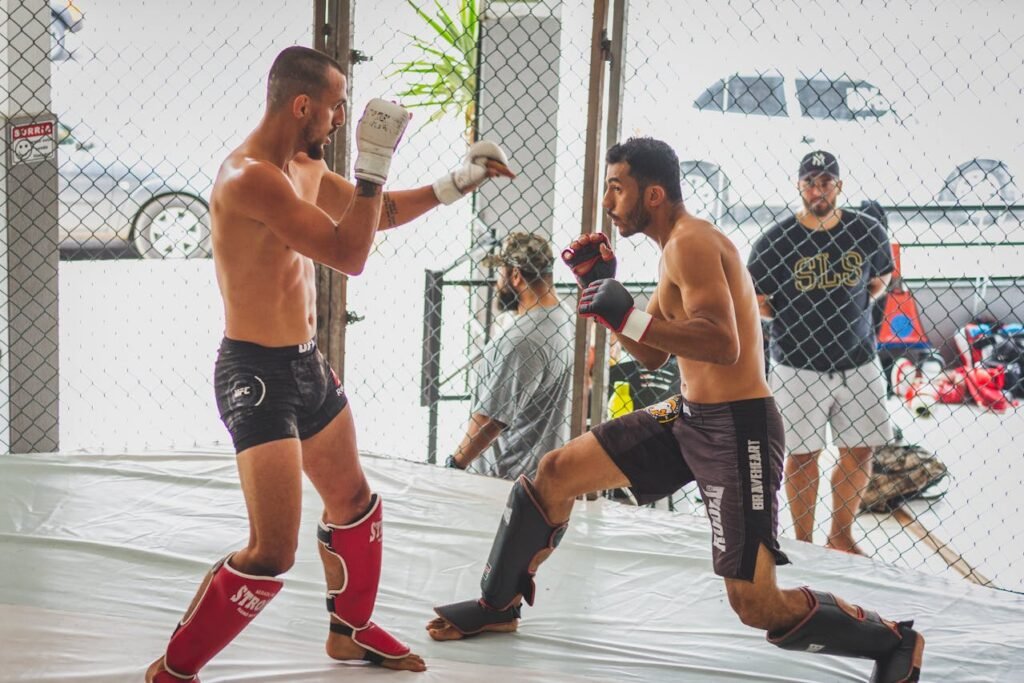
Martial arts require a lot from you: strength to hold position, strength to achieve the goal, speed to react, endurance to keep going, and resilience to hold it all together. Whether you box, judo roll, or practice another martial art, you need a body that can handle the demands of your chosen discipline.
The problem? For many fighters, “hard” training or “more” performance are still the only metrics that matter. More routes. More rounds. More exhaustion. But proper strength and conditioning (S&C) training isn’t about chasing fatigue – it’s about targeted training that leads to adaptation and makes your skills work more effectively. Smart S&C provides the physical foundation that demonstrates your technique under pressure.
Your sport/discipline comes first
Your S&C program should support your sport, not compete with it.
If you want to become a better boxeryou have to box. If you want to improve your grappling, you need mat time. Nothing in the gym can replace quality technical training.
What S&C does is fill in the gaps that your sports training doesn’t fully cover in certain progressive doses:
- General strength and power
- Speed and reactivity
- Provides robustness to joints and tissues
- Develops energy systems that meet your sporting needs
When done correctly, S&C allows you to apply your existing skills faster, harder, and longer—without failing.
Strength: The base
Power is defined as force × speed. If you want to hit harder or perform quicker takedowns, you need to be able to apply more force.
It starts with strength.
Strength training for fighters is not about bodybuilding. It’s about training your nervous system to recruit more muscle fibers more efficiently and in better coordination. The result?
- Cleaner, sharper movement
- Greater force production
- A more “connected” feeling when hitting, grabbing or throwing
Stronger muscles, tendons and bones are also more resilient. They tolerate impacts, awkward landings and climbing attempts better – which means fewer injuries and longer training time.
All other things being equal, the stronger fighter, the stronger person, has the advantage.
Speed and multi-directional movement
Strength creates potential. Speed transforms this potential into performance.
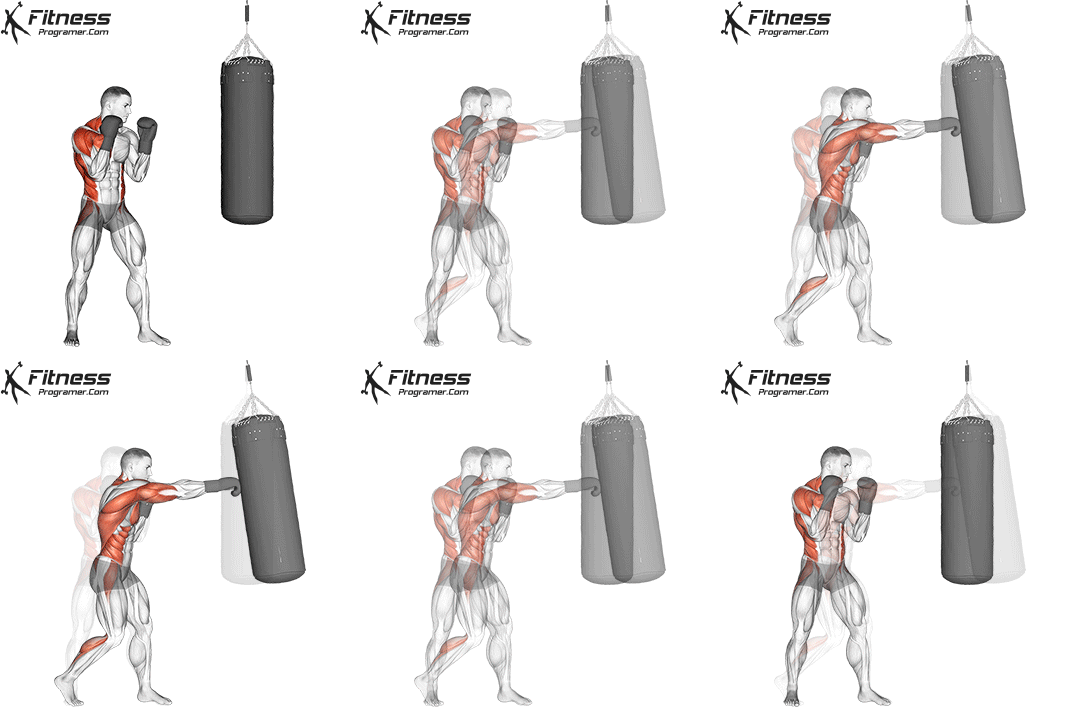
Fighters must generate power quickly: quick punches, quick level changes, quick transitions on the ground. Ballistic exercises, jumps, sprints, and medicine ball throws help you learn to express force quickly, not just release it slowly.
How you move is equally important.
Most training in the gym takes place in the sagittal plane (up-down, forward-back). But fights are chaotic and three-dimensional. They cut angles, rotate through punches, kicks, spin, reach out and circle around the opponent.
To reflect this, your S&C should include work at all levels:
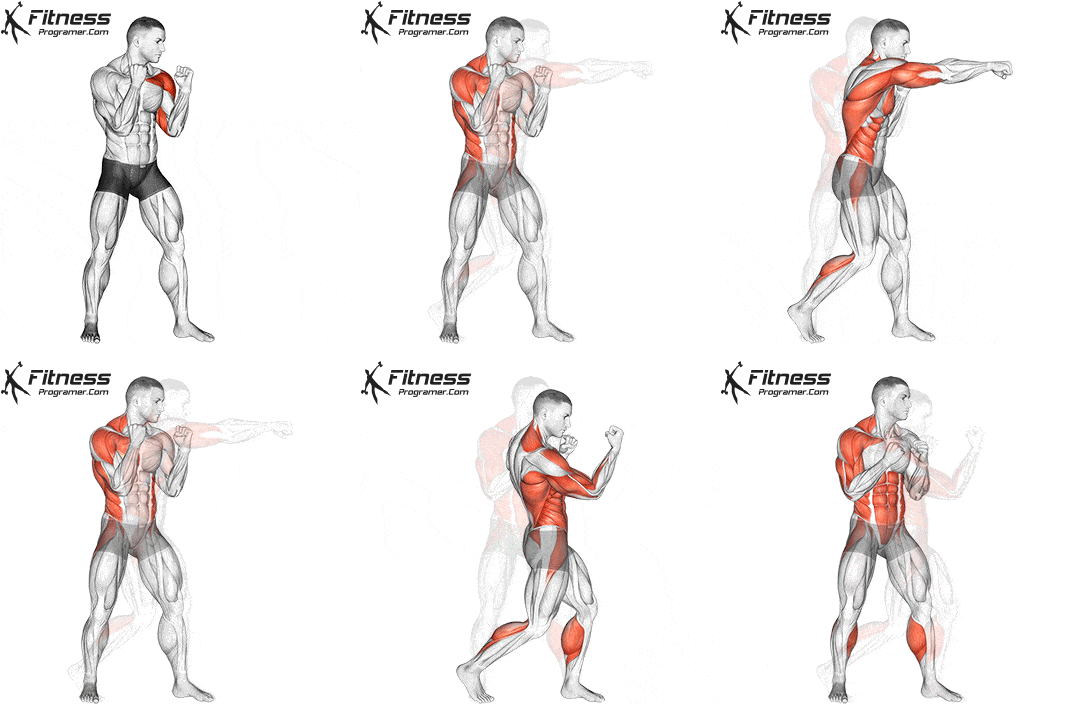
- Transverse (rotational): Rotation and anti-rotation work
- Frontal (side to side): side jumps, side jumps, side lunges
- One-legged and one-sided work: to build balance, stability and realistic strength
These movements help convert raw power into the type of agility, balance, and rotational power that can actually be used in strikes, takedowns, and scrambles.

Conditioning that actually carries over to fighting
Good conditioning is more than just random, high-intensity circuit exercises that involve lying on the floor. It’s about training the relevant energy systems so that you can consistently deliver high-quality performance across rounds, not just survive.
A balanced approach works in three main intensity zones:
1. Low intensity – building the engine
Continuous, low-intensity exercise (road work, light endurance cardio, light shadow boxing, or skipping) builds your aerobic base.
Advantages:
- Better recovery between transitions and rounds
- Lower heart rate with the same work performance
- Improved ability to handle higher training volumes
2. Moderate intensity – learn to grind
Tempo runs, controlled circuits and medium-intensity intervals are in the middle range.
These sessions:
- Develop your ability to maintain a pace even when fatigued
- Improve your ability to buffer and eliminate lactate
- Be prepared for extended arguments or high-pressure rounds where you can’t back down
3. High intensity – short, sharp bursts
Short sprints, high-intensity intervals, and short bursts near maximum effort are your maximum.
When used sparingly and consciously:
- Increase your ability to explode when necessary
- Support finishing power, whether it’s a flurry, a takedown attempt or a decisive scramble
The key is not to live in one zone all the time. Great fighters combine all three intensities throughout the week, rather than making each training session like a brutal “toughness test.”
Mobility: The silent key to longevity
Mobility is not just about being mobile; It’s about being able to move freely and efficiently in the areas your sport requires.
Poor mobility can:
- Waste energy through “leaks” in your movement
- Limit your ability to generate electricity
- Increase the risk of injury if you are forced into awkward positions
Areas every fighter should take care of:
- Spine: for rotation during punches, throws and dodges
- Ankle: for sharp, reactive footwork and stable landings
- Hips: the engine behind punches, kicks, level changes and bridges
- Shoulder: Particularly important for strikers and anyone who does a lot of grappling
You don’t need hour-long mobility sessions. Consistent, targeted work around these important joints can pay huge dividends in terms of technique, power transfer and career longevity.
Organize Your Week: The High-Low Approach
The classic mindset of a fighter is “go hard or go home” – every day, every session. This works… until it doesn’t. Over time, performance decreases, injuries creep in and you are tired more often than fit.
A better approach is this High-low training methodpopular for sprinting but extremely useful for martial arts.
The idea: alternate demanding, high-intensity days with lower-intensity days that focus on quality movement, technical work, and recovery.
For example:
- Mon – High: Strength and strength training
- Tue – Low: Aerobic conditioning and mobility
- Wed – High: Sparring/rolling plus explosive work
- Thu – Low: Core exercises, lighter technical work, mobility/recovery
- Fri – High: Heavy lifting and/or pad work/Randori
- Sat – Low: Shadow boxing, light aerobic work, exercise
- Sun – Off: Complete silence
This structure allows your nervous system to recover between big efforts, so that when you really push yourself, you can actually perform at a high level, not just survive another session.
Over weeks and months, that means more quality training and fewer junk sessions done in a state of constant fatigue.
Recovery: Where the real progress happens
Training is only half of the adaptation process. The other half is what you do outside of the gym.
Important pillars of recovery:
- Sleep: Aim for consistent, high-quality sleep to support hormone balance, tissue repair, and mental performance.
- Nutrition: Eat enough to power your training, recover, and gain weight meaningfully—not through drastic last-minute cuts.
- Hydration: Small, consistent habits during the day are better than last-minute chugs at night.
- Load management: Use off-load weeks, rest days and smart tapers before the competition.
If you ignore recovery, you will eventually be forced to stop. If you respect it, your training can actually improve and move you forward.
Basic principles for training
There is no single “magic” exercise or secret circuit that will make you a great fighter. What works is doing the basics well over time and with intention.
- Build a solid base of strength to support power.
- Train speed and direction so force can be applied quickly and at all levels.
- Condition at different intensities, not just full throttle.
- Make mobility and joint health a priority for performance and longevity.
- Recover like it matters – because it does.
If you do this consistently, you will move more purposefully, hit harder and stay in the sport longer.
In martial arts and combat sports, having more usable strength is rarely a problem. Being strong is never a disadvantage.
Contributing authors
Richard Bennett is the founder of Caliber Performance Coaching and offers strength and conditioning training, boxing coaching, etc personal training in Redditch, UK. With over 15 years of coaching experience and a long history in martial arts, he has worked with professional boxers, competitive judo athletes, amateurs and everyday clients who want to train like fighters and achieve peak performance.
We thank Richard Bennett for his valuable contributions.