

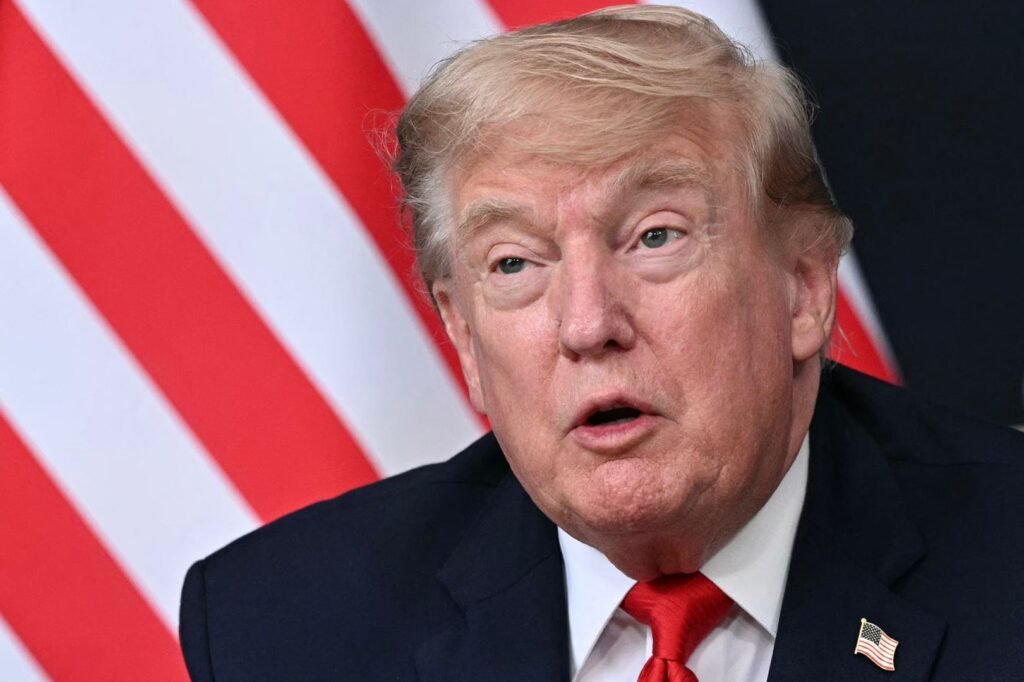
A federal court ruled against the new policy on Thursday global tariffs this US president Donald Trump imposed after a bitter loss at the US Supreme Court.
A three-judge panel at the International Trade Court in New York ruled that the 10 percent global tariffs were illegal after small businesses sued.
The court ruled 2-1 that Trump had exceeded the tariff powers that Congress had legally granted the president. The tariffs were “invalid” and “not permitted by law,” the majority wrote.
The third judge on the panel concluded that the law gives the president more leeway on tariffs.
If the government appeals Thursday’s decision, as expected, it would first go to the U.S. Court of Appeals for the Federal Circuit, based in Washington, and then possibly to the Supreme Court.
At issue are temporary 10% global tariffs that the Trump administration imposed after the Supreme Court in February struck down even broader double-digit tariffs that the president imposed last year on nearly every country in the world.
The new tariffs, which came into effect under Section 122 of the Trade Act 1974, were due to expire on July 24.
The court’s decision directly applied only to three of the plaintiffs – Washington state and two companies, the spice company Burlap & Barrel and the toy company Basic Fun!
Get breaking national news
Get breaking Canadian news delivered straight to your inbox so you never miss a trending story.
“It’s not clear” whether other companies would still have to pay the tariffs, said Jeffrey Schwab, litigation director at the libertarian Liberty Justice Center, which represented the two companies.
“We fought back and won today, and we are extremely excited,” Jay Foreman, CEO of Basic Fun!, told reporters Thursday.
The ruling marked another legal setback for the Trump administration, which has sought to protect the U.S. economy behind a wall of import tariffs. Last year, Trump invoked the International Emergency Economic Powers Act (IEEPA) of 1977 to declare the country’s long-standing trade deficit a national emergency, thereby justifying sweeping global tariffs.
The Supreme Court ruled on February 28 that the IEEPA did not authorize the tariffs. The U.S. Constitution gives Congress the power to set taxes, including tariffs, although the legislature can delegate tariff authority to the president.
Trump is widely expected to seek to replace the eliminated tariffs. The government is conducting two investigations that could lead to further tariffs.
The Office of the U.S. Trade Representative is investigating whether 16 U.S. trading partners — including China, the European Union and Japan — are overproducing goods, depressing prices and putting U.S. manufacturers at a disadvantage.
It is also examining whether 60 economies — from Nigeria to Norway, which account for 99% of U.S. imports — are doing enough to ban trade in products made with forced labor.
&Copy 2026 The Canadian Press