
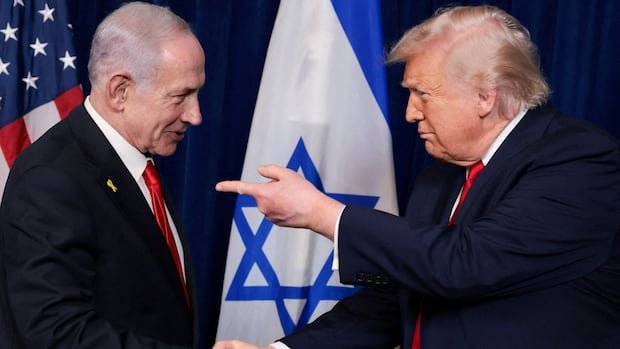
US President Donald Trump’s man in Jerusalem, former Arkansas Governor Mike Huckabee, brushed off reports that tensions had arisen between Trump and Israeli Prime Minister Benjamin Netanyahu over the Iran war and Israel’s escalating military operations in Lebanon.
“The reality is that these are two people who have great respect for each other and probably communicate more regularly than any two world leaders alive today,” Huckabee said in an interview with CBC News.
Huckabee, 70, took part in the interview at a satellite facility at the U.S. Embassy in Jerusalem, a day before Trump signaled that the U.S. and Iran agreed to a draft treaty to end the war.
Netanyahu said Israel was not a party to the Iran deal.
The interview followed reports of a tense phone call in which Trump was reportedly frustrated with Netanyahu for resuming attacks on Beirut last Sunday, days after a U.S.-brokered ceasefire. While a call on June 1stThe US leader called the Israeli prime minister “fucking crazy” and urged him not to attack the Lebanese capital.
Netanyahu briefly gave in. But just a few days later — after Hezbollah fired rockets into northern Israel — he ordered Strikes in the southern suburbs of Beiruta Hezbollah stronghold.

US Ambassador to Israel Mike Huckabee admits he did not participate in the expletive-filled phone call between US President Donald Trump and Israeli Prime Minister Benjamin Netanyahu, in which Axios reports that Trump called Netanyahu “crazy.” Huckabee says he has attended additional calls and believes tensions between the two leaders have been overstated.
Huckabee, who said he did not participate in the conference call but participated in subsequent calls, maintains that the two leaders remain close and largely aligned.
“They share great mutual interests,” he said. “They don’t always agree, but most of the time they agree — and they agree on the overriding principle, which is that Israel is a strong partner of the United States.”
“Desperation” in dealing with Iran
Ambassador Huckabee, in one of his first on-camera interviews since the United States and Israel began attacks against Iran on February 28, acknowledged the U.S. president’s growing frustration in getting Iran to agree to reopen the Strait of Hormuz and end the war.
“I see frustration and desperation in what he says,” Huckabee said. “He feels like he’s giving them every opportunity to solve the problem diplomatically. And they’ve kept putting it off and delaying it.”
The interview took place on Wednesday, a day after the conflict erupted in a series of retaliatory strikes Shot down of a US Apache helicopter over the Strait of Hormuz, testing the shaky ceasefire.

On social media, the US ambassador said that “things in the neighborhood could soon get a little tricky.” Personally, he was more diplomatic, but made it clear that Trump’s patience in negotiations with Iran was running out. “He’s a patient person, but it has its limits,” Huckabee said.
No to the Israeli takeover of southern Lebanon
In an interview with a conservative political commentator Tucker Carlson In February, Huckabee, a former pastor who describes himself as a Christian Zionist, said it would be “okay” if Israel took control of all the land granted by God to Abraham’s descendants in the Book of Genesis, an area that would include much of the modern-day Middle East.
But when asked by CBC News if he agreed with a fringe Israeli group, he called Uri Tzafonwhich advocates for the occupation and construction of permanent Jewish settlements in southern Lebanon, Huckabee quickly said no.
“I don’t know anyone in the Israeli government who supports this. Israel has made it very clear that it has no interest in annexing parts of Lebanon. That’s not on the table for them,” he said.
“Other people who say that may be so, but there is nothing in the Israeli government that would even be a wish for them. What Israel would like is a peaceful, secure border. Stop it.”

Israel’s right-wing finance minister Bezalel Smotrich has called for this Annexation of Lebanese territory south of the Litani River.
The Israeli military currently occupies about a fifth of Lebanon. More than 3,700 people have been killed in Israeli airstrikes since the Iran-backed militant group Hezbollah launched attacks from Lebanon on March 2 entered Israel after attacks on Iran, according to the Lebanese Ministry of Health.
Huckabee said he didn’t know that number but could easily say the number of Israeli soldiers killed by Hezbollah.
“It’s terrible. But who is responsible for it? I would say Hezbollah is… Just like Hamas is responsible for the destruction and devastation of Gaza,” he said.
Huckabee and his colleagues at the State Department are leading the way Peace talks between Israel and Lebanonin which officials from both countries meet in Washington for rare face-to-face talks. The next meeting is scheduled for June 22nd.
“The fact that Israel and Lebanon are sitting in the same room is in itself a historic moment,” he said.
But while representatives of the two governments meet regularly, the Israeli military and Hezbollah meet — what has rejected the ceasefire plan — keep fighting. The United Nations estimates that since the start of the last round of fighting more than a million Lebanese were pushed out.
Canada and other US allies disagree over the West Bank
On Tuesday Canada, Great Britain, France, Norway and Australia announced sanctions against several Israeli settlers and organizations for inciting and/or contributing to violence against Palestinians in the Israeli-occupied West Bank. It is a move that would have been broadly in line with the previous US administration under Joe Biden, but not the Trump administration.
“The sanctions were unfortunate, ill-timed and represent only one side of the challenge,” Huckabee said.

U.S. Ambassador to Israel Mike Huckabee says Canada’s decision to impose sanctions on Israeli settlers and organizations accused of violence against Palestinians was “unfortunate” and “untimely.”
Attacks on Palestinians have increased dramatically since October 7, 2023, when Hamas-led militants stormed southern Israel, killing about 1,200 people and kidnapping another 250. In response, Israel’s subsequent attacks on Gaza, which was controlled by Hamas, resulted in the death of almost 73,000 Palestiniansaccording to health authorities, as well as mass displacement and destruction of much of the territory.
From January 2025 to April 2026, the United Nations documented 2,595 settler attacks on Palestinians in 280 communities across the West Bank which resulted in death and/or property damage.
One of Trump’s first steps as president in the Middle East was to lift all sanctions that the US had imposed on Israeli settlers.
Huckabee acknowledged that Israel could and should do a better job of preventing settler violence and punishing those who commit violent acts against Palestinians. However, he did not say whether the US would pressure Israel to do so.

Mike Huckabee says he is “horrified” by the killing of a seven-month-old Palestinian infant by an Israeli soldier in the West Bank. The Israeli military has said it is investigating.
“Look, if there are acts of terrorism that Israelis commit against Palestinians, they should be fully condemned,” he said.
But Huckabee accused Canada and other allies of being “out of step” with the U.S. and suggested they had unfairly punished Israel.
“I mean, they’ve accused Israel of things that are completely ridiculous,” he said. “For some of these countries to accuse Israel of genocide is absurd.”