
The United States has increased its military forces in the Middle East despite President Trump promising to soon end the war against Iran. More than 5,000 Marines, paratroopers and special forces have arrived in the region in recent days, raising the prospect of a ground invasion.
Mr Trump threatened an invasion of Iran’s main oil export hub last week. Kharg Islandand “wipe out” its facilities if Iran does not allow navigation through the Strait of Hormuz to resume. Since the attack by the United States and Israel a month ago, Iran has essentially sealed it off.
To get to Kharg Island, U.S. amphibious troops – which experts say would most likely be part of any ground operation – would have to advance about 500 miles into the Persian Gulf. “That would be very risky,” said Mark F. Cancian, senior adviser at the Center for Strategic and International Studies and a retired Marine Corps colonel. “That’s why I think opening the strait could be the first thing.”
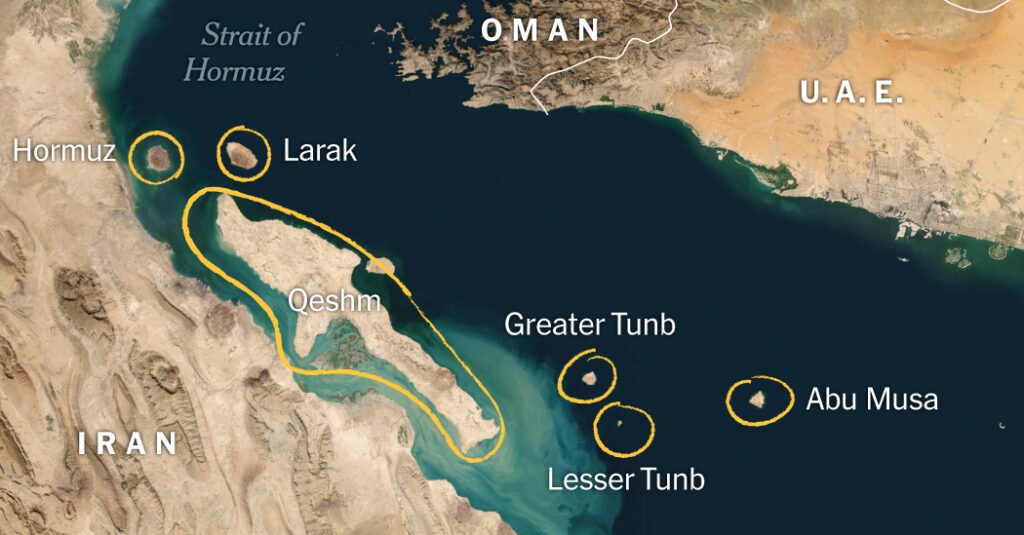
U.S. officials say the president is also considering whether to do so Conquer islands which lie in and near the strait to open the waterway which in ordinary times leads a most of the world’s oil and gas reserves.
With military outposts on several islands as well as on the coast, Iran can quickly cover the narrow shipping lanes with drones, anti-ship missiles and speedboats.
Given Iran’s firepower, the United States would have to conquer the entire archipelago to try to open the strait, said Farzin Nadimi, a senior scientist at the Washington Institute, including Qeshm, Larak, Abu Musa and the Tunb Islands. “You have to take them all,” he said.
The United States has deployed 2,000 paratroopers and special forces to the region. If they landed on the islands, they would be able to dismantle tunnel networks and underground missile bases that were “inaccessible even to bunker-buster bombs,” Dr. Nadimi.
Commanders would have to decide whether to destroy the facilities and withdraw or hold the islands longer to help secure the strait. They could also offer the United States leverage in negotiations with Iran.
But a longer stay would require heavily equipped Marines and air defenses to protect them from Iranian drones, missiles and missiles from the coast. That would be a “high-risk company with a high risk of accidents,” said Dr. Nadimi.
A ground operation alone would not guarantee that shipping traffic would return to the Strait in significant numbers.
“You have to reassure the sailors, you have to reassure the shipping companies and insurance companies that the passage is safe enough,” said Andreas Krieg, a lecturer at the School of Security Studies at King’s College London.
Even if one or more islands in or near the strait were captured, Kharg Island would have significant strategic value to Mr. Trump.
Ninety percent of Iran’s oil is exported from the island, and heavy U.S. attacks there in March did not stop oil shipments. Satellite images showed that tankers continued to fill the island’s export terminals in the days after the attacks.
Experts believe that a US conquest of Kharg Island would pose a significant burden on the Iranian economy. “It is the Achilles heel of the regime’s oil export infrastructure,” said Behnam Ben Taleblu, senior director of the Iran program at the Foundation for Defenses of Democracies.
But any attempt to land US troops on the island would also be dangerous due to the hilly terrain and military presence. The flammable oil stored there poses its own dangers.
Experts warn that Iran could pursue a scorched earth policy and destroy oil facilities on the island rather than allow US forces to take them. And there are political risks for the Trump administration.
If the Marines captured an island but failed to force Iran to surrender, an eventual withdrawal could look like a defeat. And if they tried to hold onto any islands, Iran would most likely try to turn it into a war of attrition.
“What they want is maximum casualties for Americans, because it creates images that will change public opinion in the United States,” Krieg said.