
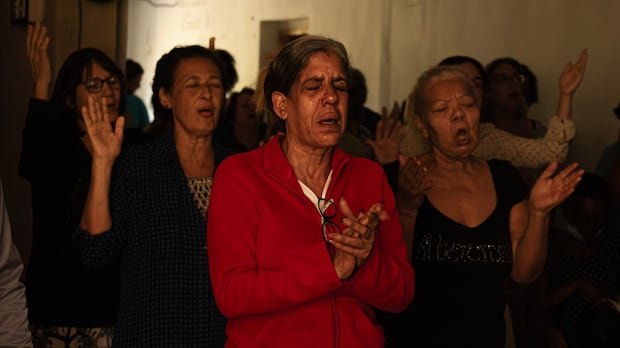
In the middle of a worship song Sunday, the morning after the second collapse of Cuba’s power grid in six days, the Renewal preacher at Christ Church in Havana said he had a message to deliver that came to him in a dream.
Sunlight streamed through an open window to the right of the raised platform on which he stood, while a battery-powered lamp attached to the ceiling shone dimly across the pulpit. A row of table fans with dangling plugs lined the concrete walls of the shaded sanctuary.
Nearly every plastic and metal chair was occupied in this small two-unit evangelical church built along a block of terraced houses in East Havana that, like most of the city that morning, had no electricity.
“If you’re thinking about giving up, don’t give up, keep going, keep going,” said Pastor Daniel Cisnero, sweat on his brow, eyes closed, his voice a scream.
“It’s not the time to give up, it’s the time to move forward and hold God’s hand.”
He kept saying, “Don’t give up.”
The congregation pushed forward with arms raised. A man strummed an acoustic guitar while Daymer Alfonso Monterrey, 37, tapped out a steady rhythm on the cajon, a box-shaped drum.

“We go through, as you know, difficult times, moments when our faith is tested. But faith in (God) is enough for us,” Monterrey said in an interview with CBC News after the service.
“Sometimes we have nothing in the refrigerators, we live in hard times with power outages… God is above the tough times. He is above not having a plate of food to eat sometimes,” he said.
Renewal at Christ Church provides members with a meal on Sundays and runs a weekday program to send meals to the elderly.
“Our church not only does spiritual work, but we also do social work in our community to help those in need,” Cisnero said. “Jesus preached, but he also responded to people’s needs.”
Cuba faces an uncertain future as President Donald Trump’s U.S. administration appears to want to force the collapse of the island’s communist government through an oil blockade that will exacerbate the country’s existing infrastructure and economic weaknesses.

Cuba’s aging energy infrastructure, which relies heavily on oil to generate electricity, is suffering from fuel shortages. The energy shortage has triggered a cascade of crises that has affected public services and made food prices almost unaffordable for large parts of the population.
Last Monday, the country experienced a nationwide power outage that lasted just over 30 hours. Cuba’s Energy and Mines Ministry announced at 6:45 p.m. ET on Saturday that the country was hit by a power outage for the second time.
Cuban authorities said late Sunday that Havana’s power grid, which is regularly rationed between districts, was functioning normally again.

After the second nationwide blackout in a week, power is slowly returning to Cuba. As the UN says the country is on the brink of a humanitarian crisis, CBC News is in Havana, where some have found hope in community and their faith.
Authorities said work is continuing to restore power supplies in the rest of the country.
The United Nations has warned that the oil blockade could plunge Cuba into a humanitarian crisis. But the US continues to take a hard line on the blockade and recently warned a Russian tanker heading to Cuba.
Trump has also called on Cuba’s long-time ally Mexico to stop oil shipments to the island nation.
Since then, Mexico has sent at least two aid shipments to Cuba, and its government has quietly helped a group of activists who have championed Cuba’s cause by arranging a shipment of supplies to the country by sea and air.
Mexican President Claudia Sheinbaum made a personal donation to the Flotilla Nuestra América, said Nicole León Avilés, one of the organizers from Spain, in an interview with CBC News.
Sheinbaum’s party, the National Regeneration Movement (Merena), along with government lawmakers also donated to the flotilla, organizers said.

The devastating US oil embargo against Cuba is making life on the impoverished island even more desperate. Gasoline now sells for $10 a liter on the black market, and a sharp decline in tourism has robbed the economy of what little foreign revenue it had.
Avilés left Puerto Abrigo in Mexico’s Yucat on Friday on a fishing boat named Granma along with more than two dozen shipsTon state.
The group says it is carrying several tons of relief supplies, including bicycles, personal care products, diapers, milk powder, non-perishable food and medicine.
They are expected to arrive in Havana on Monday.
Granma is the name of the yacht that brought Fidel Castro, Che Guevara and other revolutionaries from Mexico to Cuba in 1956 to begin the armed campaign to overthrow the regime of Fulgencio Bautista.
Other members of the Nuestra América campaign from different parts of the world landed in Cuba late last week and performed a concert with the Irish rap group Kneecap on Saturday during a local festival.
The band finished their performance a little more than an hour before Cuba’s power grid failed early Saturday evening, plunging the country into darkness.

A crippling US oil embargo is making life in Cuba increasingly desperate. Power outages, water and fuel shortages are prompting the United Nations to warn of a humanitarian crisis. The Cuban government gave CBC’s Jorge Barrera direct access to a hospital in Havana, where health care providers shared how the crisis is affecting their work.
Shortly thereafter the blackoutAs the outages are called here, Claudia Hernández, 16, braided the hair of her boyfriend Adrian Duarte, 16, in the light of the cell phone flashlights that two of her friends were holding on the second floor of a low-rise apartment in Old Havana.
Next door, Hernández’s mother, Lisandra Yanes Barrios, 37, placed a battery-operated lamp above the entrance to the kitchen, where a pot was simmering on a gas stove.
“This has become so common that you just accept it and have no other choice,” said Yanes Barrios.
She said the family still had 55 liters of water in two tanks to survive the recent power outage. When the power goes out, the water pumps shut down, stopping the flow of water.
Hernández shrugged.
“We’re used to it,” she said.
The only thing that has changed for her, she said, is the importance of the external charger for her cell phone.
“I used to use less, now it’s more important,” Hernández said.
Yanes Barrios said the country would be in a bad situation even without an oil blockade.
“In my opinion (the oil blockade) has nothing to do with it,” she said. “We were forced to adapt.”
On the street in front of her building, a little girl was playing hopscotch with a flashlight.