
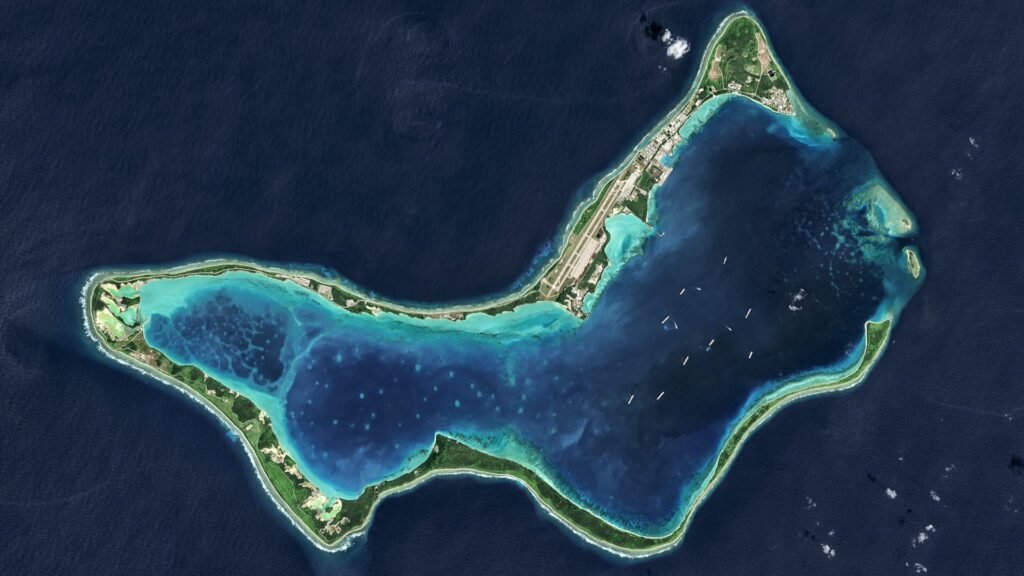
Diego Garcia, a British Indian Ocean Territory and the largest of the islands in the Chagos Archipelago on July 2, 2013 in Diego Garcia, British Indian Ocean Territory.
USGS NASA | Gallo Images | Getty Images
Iran has unsuccessfully attacked a joint US-UK military base in the Indian Ocean, the UK said on Saturday.
“Iran’s unsuccessful attack on Diego Garcia came before yesterday’s update on US use of British bases,” Britain’s Ministry of Defense (MoD) told CNBC in an emailed statement.
British Prime Minister Keir Starmer’s office said on Friday that ministers had done so approved US forces Use of British bases to defend the region, including “US defense operations to degrade missile sites and capabilities used to attack ships in the Strait of Hormuz.”
The Defense Ministry said the U.K. had given permission for the U.S. to use its bases at RAF Fairford in England and Diego Garcia in the Chagos Islands for “specific and limited defense operations.”
Iran fired two intermediate-range ballistic missiles at Diego Garcia, but “failed to hit the U.S. and British military base in the Indian Ocean,” according to the Wall Street Journal first reported on Friday, citing several U.S. officials.
One of the missiles failed in flight, while a U.S. warship fired an SM-3 interceptor at the other, although it could not be determined whether the interception was successful, the paper said.
“Iran’s reckless attacks across the region and hostage-taking of the Strait of Hormuz pose a threat to British interests and British allies,” the UK said in its statement. “Royal Air Force jets and other UK military assets continue to defend our people and personnel in the region.”
The reported attack was the first operational use of intermediate-range ballistic missiles by Iran and a significant attempt to reach far beyond the Middle East and threaten U.S. interests, the Wall Street Journal said.
Great Britain agreed in May 2025 to hand over sovereignty over the Chagos Islands, where Diego Garcia’s base is located, to Mauritiuswhich has long disputed Britain’s acquisition and ownership of the Indian Ocean archipelago.
US President Donald Trump has repeatedly criticized the British plan.
Strait of Hormuz threat “degraded”
On Saturday, Admiral Brad Cooper, head of U.S. Central Command, praised the U.S. military’s progress in the war, including the deployment of several 5,000 bombs at an underground facility along the Iranian coast to open the Strait of Hormuz.
“Iran’s ability to threaten freedom of navigation in and around the Strait of Hormuz has been compromised,” he said in one Post on X.
Meanwhile, Trump told reporters on Friday that he was not interested in a ceasefire with Iran.
“We could have a dialogue, but I don’t want a ceasefire,” Trump said White House South Lawn before leaving for Florida. “You know you won’t enter into a ceasefire if you literally wipe out the other side.”
“They don’t have a Navy. They don’t have an Air Force. They don’t have any equipment,” Trump continued.
In one Truth Social post Later Friday afternoon, Trump claimed that the U.S. is “moving very close to achieving our goals as we consider ending our major military effort in the Middle East.”
The US allows the sale of Iranian oil at sea
The war, which began on February 28 with U.S. and Israeli airstrikes against Iranian targets, has effectively sealed off the narrow and economically important Strait of Hormuz that separates Iran from the United Arab Emirates.
Around a fifth of the world’s oil is transported across the strait. Daily transit calls have fallen to nearly zero from highs above 120 seen earlier this year, according to data analyzed by Charles Schwab. Much of the Gulf’s crude oil typically goes to Asia.
Benchmark Brent crude oil May futures rose 3.26% to $112.19 a barrel on Friday. the highest closing price since July 2022. US West Texas Middle School April futures settled 2.27% higher at $98.32 a barrel.
The Trump administration’s latest attempt to cut prices came late Friday waived sanctions about purchasing Iranian oil at sea for 30 days. The move is expected to bring 140 billion barrels of oil to global markets, according to US Treasury Secretary Scott Bessent posted on X.
“This temporary, short-term authorization is strictly limited to oil already in transit and does not permit new purchases or production,” he said. “In addition, it will be difficult for Iran to access the revenues generated, and the United States will continue to exert maximum pressure on Iran and its ability to access the international financial system.”
The license authorizing sales and delivery, published after market hours on the Treasury Department’s website, allows Iranian oil to be imported into the United States if necessary for sale, delivery or offloading. Since the Iranian Revolution in 1979, no significant Iranian oil has been imported into the United States.
Iran promises safe passage for Japanese ships
Iranian Foreign Minister Abbas Araghchi said Tehran was ready to facilitate this Passage of Japanese ships through the Strait of Hormuz, adding that negotiations with Japan on the issue are still ongoing.
“We have not closed the strait. It is open,” Japanese news agency Kyodo quoted Araghchi as saying in an interview on Friday.
He also said that Iran was seeking “not a ceasefire, but a complete, comprehensive and permanent end to the war.”
Araghchi said Iran had not closed the strategic waterway but had imposed restrictions on ships from countries involved in attacks against Iran and offered assistance to others amid heightened security concerns, Kyodo reported.
He added that Iran was ready to ensure safe passage for countries like Japan if they coordinate with Tehran.
The supply of Iranian gas to Iran is reportedly resuming
Iran’s gas supplies to Iraq have resumed at a rate of five million cubic meters per day, the Iraqi Electricity Ministry said on Saturday, according to the state news agency.
Gas supplies have been disrupted since the Israeli attack on Iran’s main gas field, South Pars, on Wednesday.
— Reuters contributed to this report