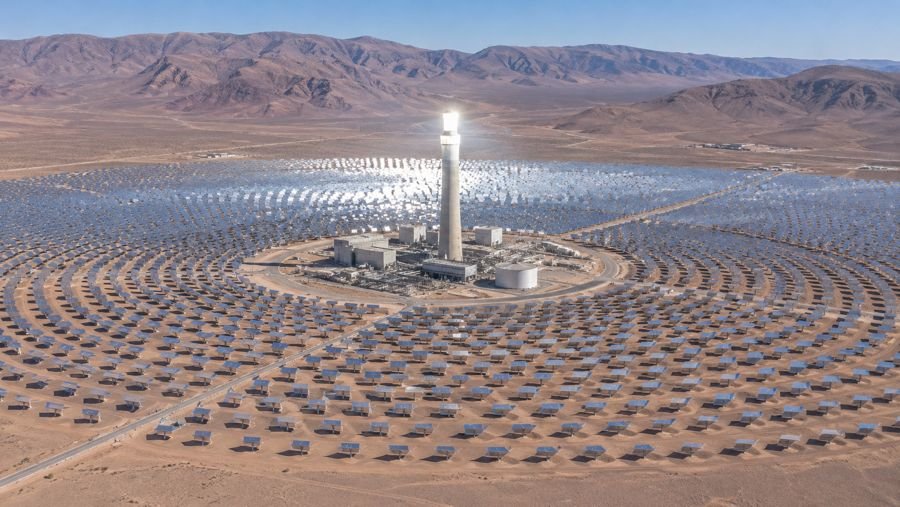
A few kilometres outside Ouarzazate, on the stony plateau at the edge of the Sahara, rows of curved mirrors and a tall central tower make up one of the world's largest solar complexes. Noor Ouarzazate started producing electricity in February 2016. Ten years later it remains the flagship of Morocco's energy transition.
Four plants, three technologies
Noor is not one power station but four, built in phases and managed by MASEN, the Moroccan Agency for Sustainable Energy.
| Plant | Capacity | Technology |
|---|---|---|
| Noor I | 160 MW | Parabolic trough mirrors (concentrated solar power) |
| Noor II | 200 MW | Parabolic trough mirrors |
| Noor III | 150 MW | Solar tower with molten-salt storage |
| Noor IV | about 70 MW | Photovoltaic panels |
| Total | about 580 MW |
The complex covers about 3,000 hectares and cost more than $3 billion, financed with support from the World Bank, the African Development Bank, the European Investment Bank and other lenders.
Why concentrated solar power?
Most solar farms use photovoltaic panels that turn light directly into electricity, which stops when the sun goes down. Noor I to III instead use mirrors to concentrate sunlight and heat a fluid. That heat can be stored in tanks of molten salt and used to drive turbines after sunset. This allows the plants to keep supplying the grid into the evening, when demand in Morocco is highest.
The trade-off is cost. Concentrated solar power is more expensive than photovoltaic panels, whose prices have fallen sharply since Noor was planned. That is why newer Moroccan solar projects mainly use photovoltaic technology.
How big is it in practice?
According to World Bank figures, Noor can meet the electricity needs of more than one million people. It also reduces Morocco's dependence on imported fossil fuels, which historically covered most of the country's energy needs.
The national target
Morocco first aimed for 42% of installed electricity capacity from renewables by 2020, then raised the goal to more than 52% by 2030. According to the Ministry of Energy Transition, renewables now account for about 44% of installed capacity, from hydropower, wind and solar.
Two points are worth keeping in mind:
- The target refers to installed capacity, not the share of electricity actually produced. Because solar and wind do not run all the time, their share of production is lower than their share of capacity.
- Integrating more renewable power requires better grids, storage and interconnections, which experts identify as the main bottleneck.
Local effects
Ouarzazate is best known for its kasbahs and film studios, and Noor has added a new industry to the region. More than 30% of the content of the complex was sourced locally, including mirror assembly, steel and civil engineering. One issue often raised about concentrated solar power in desert areas is water, since the plants need it for cleaning mirrors and, depending on the design, for cooling.