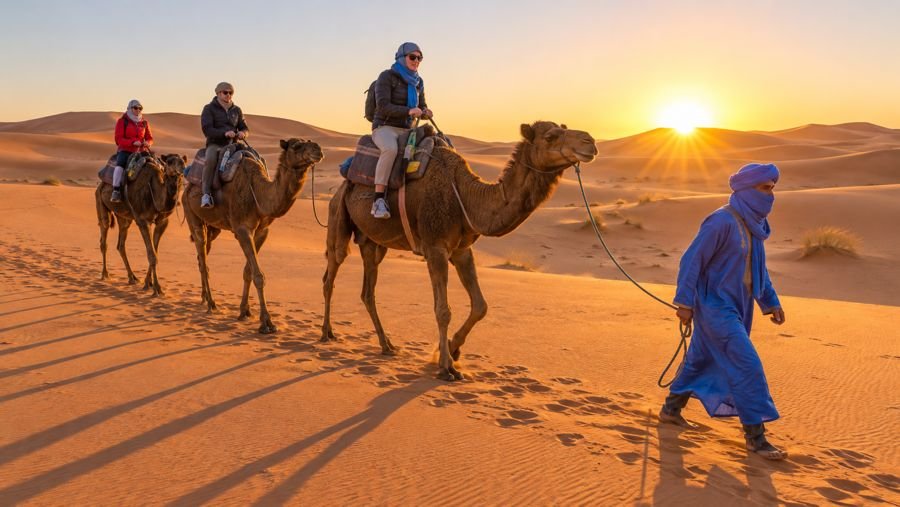
Erg Chebbi is the sea of sand dunes most people picture when they think of the Moroccan Sahara. It lies beside the village of Merzouga in the Drâa-Tafilalet region, near the Algerian border. This guide covers the practical side: getting there, timing and what to check before you book.
The dunes in brief
- Size: about 22 to 28 km from north to south and 5 to 7 km wide, depending on the source.
- Height: the tallest dunes rise about 150 metres above the stony plain around them.
- Access: paved road all the way to Merzouga and the neighbouring village of Hassilabied, at the edge of the sand.
How far is it?
| From | Approx. distance | Driving time without long stops |
|---|---|---|
| Marrakech | about 560 km | 9 to 10 hours |
| Fès | about 470 km | 7 to 8 hours |
| Ouarzazate | about 360 km | 5 to 6 hours |
| Errachidia | about 130 km | about 2 hours |
Merzouga is not a day trip from Marrakech. Most visitors allow at least three days and two nights from Marrakech or Fès, with one night on the way (often in the Dadès or Todra area) and one night in the dunes.
Getting there
By road from Marrakech
The classic route crosses the High Atlas at the Tizi n'Tichka pass (about 2,260 m), then continues through Ouarzazate, the Dadès valley, Tinghir, Erfoud and Rissani.
By road from Fès
The northern route goes through Ifrane, Midelt, the Ziz gorges and Errachidia.
By plane
The nearest airport with scheduled flights is Moulay Ali Cherif airport in Errachidia, with flights from Casablanca. From there it is about two hours by road.
By bus
Supratours has run a direct bus from Marrakech to Merzouga, and CTM serves Rissani, about 35 to 40 km away. Check current timetables before you plan around them.
When to go
The most comfortable months are October to April. Days are warm and nights can be very cold in December and January, so pack warm layers. From June to early September daytime temperatures are extreme, and many travellers avoid the dunes during that period. Spring can bring sandstorms.
What a desert night usually involves
Most camps follow a similar pattern: arrival in Merzouga in the afternoon, a camel ride or a 4x4 transfer to the camp around sunset, dinner and music, a night in a tent, and a climb up a dune at sunrise. Camps range from basic to luxury, with private bathrooms and electricity.
Before you book, check
- The exact location of the camp. Ask for a map pin. Some "desert camps" are close to the road rather than in the dunes.
- What is included: transfers, meals, camel ride, heating in winter.
- Bathrooms and water: shared or private.
- Cancellation terms, especially in sandstorm season.
- Licensed operators: use registered guides and agencies, and agree prices in writing.
Respecting the place
Merzouga and Hassilabied are living villages. Dress modestly in the village, ask before photographing people, take your rubbish back with you and stay on established tracks with vehicles, since off-road driving damages the dunes and disturbs camps.
Nearby
- Rissani: the historic heart of the Tafilalet oasis and its weekly market.
- Erfoud: known for fossils and marble workshops.
- Khamlia: a village known for Gnawa music.
- Todra gorge: high canyon walls near Tinghir, often visited on the way.